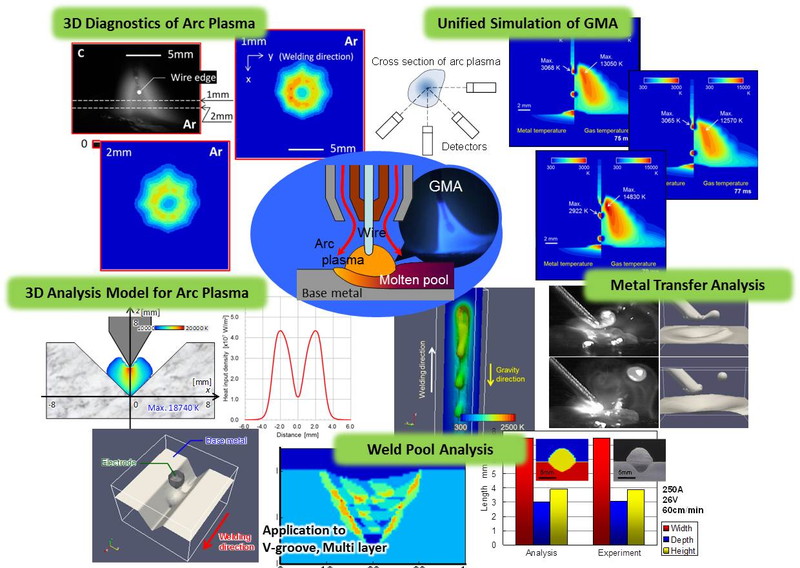
We are promoting studies to elucidate, predict, and control the phenomena in materials processing using laser and plasma based on the physics of the process by combining and making full use of an advanced measurement and a numerical simulation technology. Utilizing the knowledge obtained, we aim to develop a unprecedented process based on the universal truth.
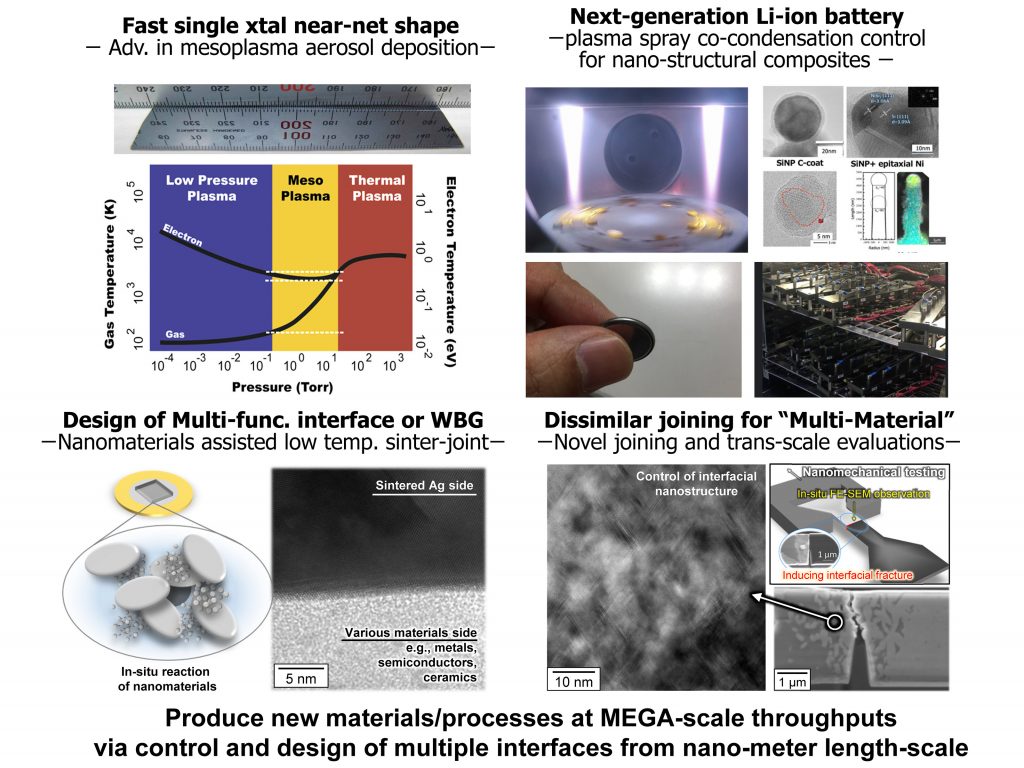
To respond to technological demands for development of future society, mission of our lab is to aim at advancement in materials design and processing, baring in mind the nano-meter length scale structural/interface control at affordable MEGA-scale production. In particular, making the best of and advancing the knowledge “Plasma Materials Engineering”, we challenge to propose novel materials/processing that attain both high quality and low-cost, multi-functionality and low environmental load simultaneously. Current research targets include; control of plasma spray co-condensation for nano-composite materials production for next-generation all-solid state lithium-ion batteries, design of multi-functional interface and development of low-temperature nanoparticle-assisted sinter-joint for wide-bandgap power device, development of dissimilar material joints to proceed “multi-material” technologies.
Materials Joining Process Area
Multi-material technology, which combines different materials in the right place for the right purpose, is an important approach for realizing lightweight and high-performance automobiles and transportation systems, thereby contributing to the achievement of a carbon-neutral society. This technology has also been identified as one of the key technological fields in Japan’s Materials Innovation Strategy.
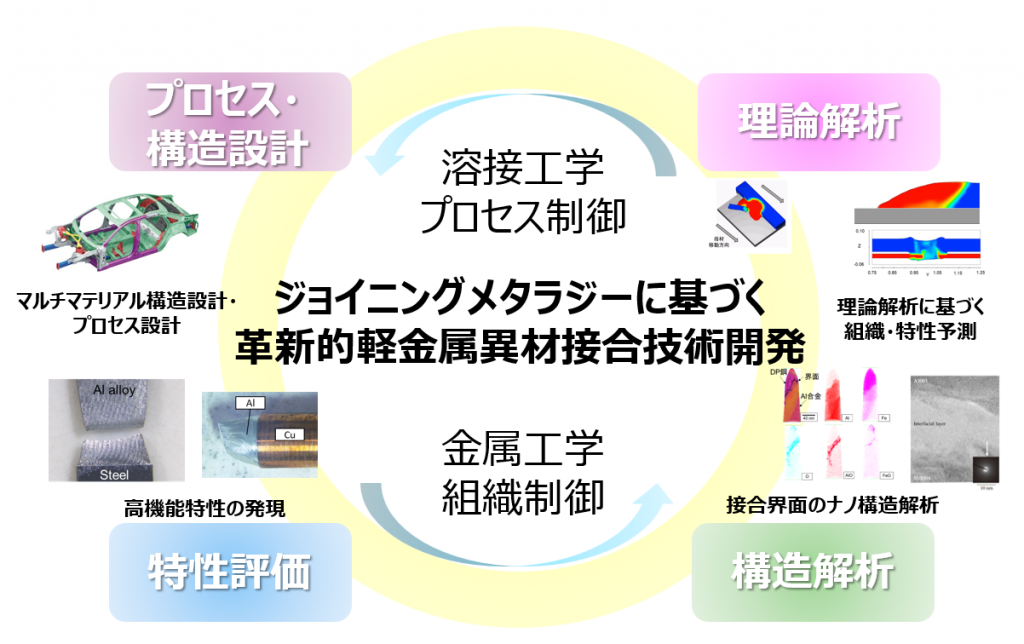
In materials joining process area, we conduct research on dissimilar-material joining technologies that enable the precise metallurgical joining of different materials through the control of interfacial microstructures and reactions. In particular, based on Joining Metallurgy, which integrates metallurgy and welding engineering, we promote innovative research on dissimilar-material joining that consistently covers process design, interfacial microstructure control, and property prediction. Through these efforts, we aim to realize advanced manufacturing technologies that achieve lightweight, high-strength, and high-functional structures by enabling material combinations that were previously difficult to join.
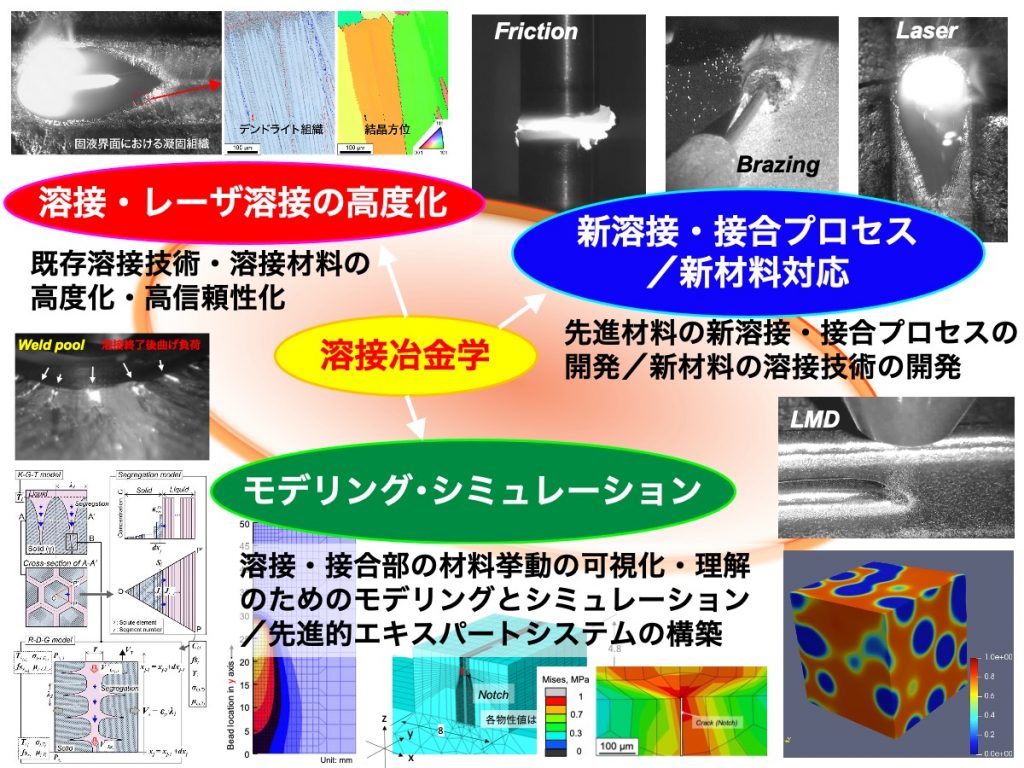
We are advancing research in welding and joining materials science through an interdisciplinary approach that integrates materials science, mechanics, and process engineering. Specifically, our research focuses on elucidating multiscale coupled materials behavior through integrated visualization and atomistic approaches, developing new directions in interfacial joining science for emerging materials and processes, and clarifying metallurgical phenomena in welding and joining through modeling-based prediction and control. Through these efforts, we aim to achieve advanced prediction of materials behavior, optimization of joining processes, exploration of underlying mechanisms, verification of integrity and reliability, and enhancement of the performance of welded and joined components. Ultimately, our goal is to establish a systematic framework for welding and joining process metallurgy and to develop technologies that contribute to improved reliability of welded and joined structures.
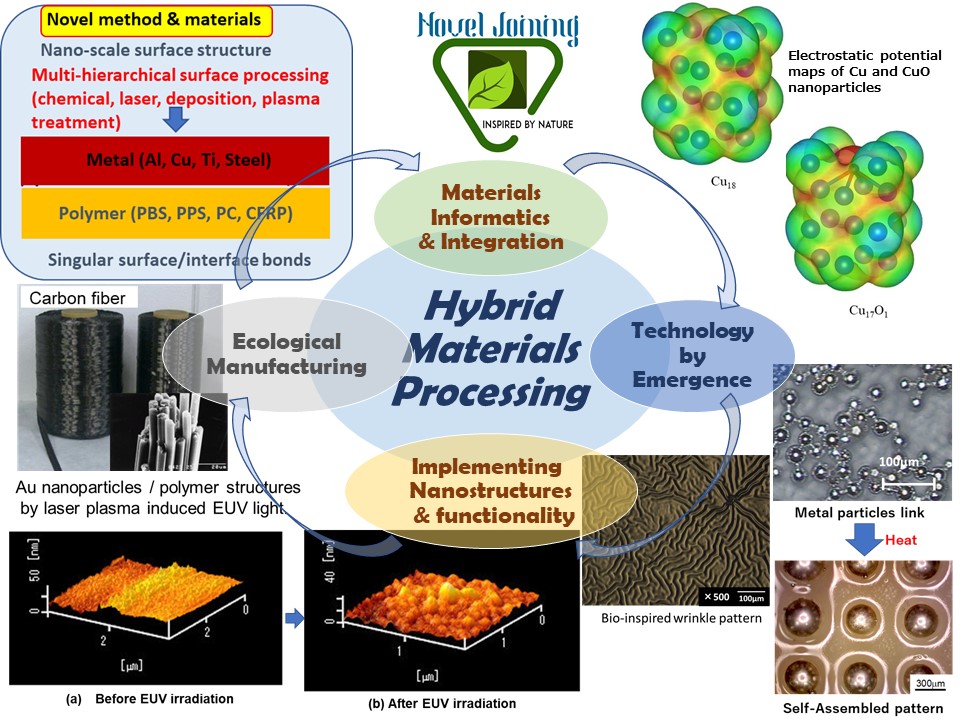
For a low-carbon society, we develop biomimetic materials and manufacturing processes that weave together “engineering knowledge” and “biological knowledge” that humans and nature have accumulated. Our research consists of three main pillars; Development and application of nanomaterials that realize energy saving and energy creation through data science, Multi-materials technology that “connects and disconnects” materials with completely different properties, Nano/micro joining of electronic materials and advanced semiconductor packaging. By making full use of theory, experiments, and simulations of manufacturing process from atomic/molecular bonding to multi-materialization, we will evolve hybrid materials and manufacturing technologies that will bring about innovations in future manufacturing “Monodukuri”.
Top